Upgrading or replacing your blown-in cellulose attic insulation or blown-in fiberglass attic insulation is one of the highest-return improvements you can make to an Arizona home. The U.S. EPA (through ENERGY STAR) estimates homeowners save an average of 15% on heating and cooling costs by air sealing and adding attic insulation. In Arizona’s hot climate (Climate Zones 2–3), attics should reach R-38 to R-49. If you can see your attic floor joists, you need more insulation. At Thermo-S Insulation, we bring your attic up to R-38, pair it with required air sealing, and apply your SRP rebate of up to $600 (75% of the project cost) instantly to your invoice — all backed by a lifetime warranty.
Heat follows simple physics: it rises, and it always moves toward cooler areas. During an Arizona summer, an unshaded attic can climb past 130°F, and that heat presses relentlessly down into your living space. In the cooler months, the warmth you pay to generate escapes straight up through the ceiling. The attic is the single largest surface where your conditioned air meets the outdoors, which is exactly why it delivers the biggest efficiency payback of any insulation upgrade.
ENERGY STAR puts it plainly, describing the attic as “the easiest place to add insulation to improve your comfort and the energy efficiency of your home.” Unlike walls, which usually require opening up drywall or siding, most attics are accessible and can be topped up or fully replaced in a single visit. That combination of high impact and low disruption is why attic insulation consistently tops the list of cost-effective energy retrofits.
The concept behind insulation performance is R-value, which the Department of Energy defines as a measure of insulation’s resistance to heat flow. The higher the R-value, the better the material resists heat transfer. When your attic falls below the recommended R-value, your HVAC system runs longer and harder to hold a set temperature, driving up both your energy bills and the wear on expensive equipment.
You don’t need special tools to get a strong first read on whether your attic is under-insulated. ENERGY STAR recommends a simple visual test: look across the span of your attic. If your insulation is level with or below the floor joists — meaning you can easily see the wooden joists — you should add more. If the insulation sits well above the joists so you can’t see them, you likely have enough.
Beyond that quick check, several everyday symptoms point to an insulation deficit. Uneven temperatures from room to room are among the most common complaints, where one bedroom bakes while another stays cold. Persistent drafts along ceilings and walls suggest air moving freely between your attic and living space. Summer cooling bills that climb faster than expected often trace back to a superheated attic radiating downward. An HVAC system that seems to run nonstop is frequently fighting a losing battle against poor insulation.
Insulation that is visibly thin, matted down, water-stained, or unevenly distributed — thick in the center but sparse along the eaves — is a clear sign the material is no longer doing its job. This uneven coverage is extremely common; ENERGY STAR specifically warns that “sometimes there is enough insulation in the middle of the attic and very little along the eaves.”
Insulation isn’t one-size-fits-all. Recommended levels depend on your climate zone, based on the 2021 International Energy Conservation Code. Arizona falls into Climate Zones 2 and 3, which means attics should generally be insulated to R-38 to R-49 on a retrofit. Here’s how ENERGY STAR’s retrofit guidance breaks down for Arizona and the surrounding zones:
| Climate Zone | Uninsulated Attic | If You Already Have 3–4 Inches | Typical AZ Areas |
| Zone 1 (hottest) | R-30 | R-25 | — |
| Zone 2 | R-49 | R-38 | Phoenix, Mesa, Tempe, Tucson |
| Zone 3 | R-49 | R-38 | Higher-elevation AZ |
| Zone 4A/4B | R-60 | R-49 | — |
| Zones 5–8 (coldest) | R-60 | R-49 | — |
For most Greater Phoenix homes, the practical target is R-38, which is also the minimum required to qualify for the SRP insulation rebate. In terms of depth, R-38 generally means roughly 13–16 inches of blown-in cellulose or 10–16 inches of blown-in fiberglass.
The critical detail most homeowners miss: R-value is only achieved at the correct installed thickness with even coverage. At Thermo-S Insulation, we install to manufacturer specifications so the insulation delivers the R-value on the label — not a number that falls short in the corners where heat sneaks through.
The headline benefit is money back in your pocket every month. The EPA estimates homeowners save an average of 15% on heating and cooling costs — about 11% of total household energy costs — by air sealing and adding attic insulation. Because cooling represents the largest slice of most Arizona utility bills, a 15% reduction compounds year after year. Blown-in cellulose typically lasts 20 to 30 years, and quality fiberglass won’t settle, rot, or deteriorate, so the savings continue long after our crew leaves.
Our customers consistently tell us the comfort improvement is felt almost immediately. A common scenario we solve: a home where the only way to cool a hot back bedroom was to freeze the living room. Once we bring the attic up to proper levels — often paired with duct correction — the temperature evens out across the entire home. Proper insulation stops your attic from acting like a heat reservoir, so your thermostat setting finally matches how each room actually feels.
Every hour your air conditioner runs is wear on the compressor, blower, and other components. When your attic holds conditioned air in, the system reaches its target temperature faster and cycles less. That means fewer repairs, a longer equipment lifespan, and one less big-ticket replacement in your future — a benefit that never appears on the energy bill but is very real in Arizona’s demanding climate.
Dense blown-in insulation does double duty as a sound barrier. Cellulose in particular uses dense-fill technology that reduces sound transmission from outside and between rooms, and fiberglass similarly dampens sound transfer. For homes near busy streets or flight paths, the acoustic upgrade is an underrated bonus.
Cost is the most common hesitation, and it’s also the most easily addressed. As an SRP-approved, BPI-certified contractor, Thermo-S Insulation applies your rebate of up to $600 or 75% of the project cost directly to your invoice, instantly — no reimbursement forms, no waiting. On the federal side, the Energy Efficient Home Improvement Credit may apply to qualifying insulation and air-sealing upgrades. We identify what you qualify for and handle the paperwork.
Energy efficiency is increasingly a selling point in the Arizona market. A documented insulation upgrade, lower historical utility bills, and a transferable lifetime warranty all strengthen a home’s marketability. Buyers recognize that a properly insulated home means lower ownership costs from day one.
Modern blown-in materials are engineered for wellness and sustainability. The Sanctuary® cellulose we install is made from roughly 85% recycled paper, treated to be fire- and mold-resistant, and manufactured through a carbon-neutral process that diverts about 160,000 tons of paper from landfills each year. Our high-density fiberglass is GREENGUARD Gold certified, formaldehyde-free, and made with recycled content. A stable, well-sealed attic also reduces the moisture swings and drafts that can affect indoor air quality.
Cost depends on your attic’s square footage, the R-value you’re starting from, whether old material needs removal, and the insulation type. The table below shows typical estimated ranges for Arizona homes in SRP territory — use it as a planning guide, not a quote. Every home is different, which is why we provide a free, no-obligation inspection and a custom quote before any work begins.
| Scenario | Estimated Cost Range* | Material R-Value Target | Expected Lifespan | Notes |
| Blown-in cellulose (top-up to R-38) | ~$1.10–$2.33 / sq ft | R-38 | 20–30 years | Dense, excellent sound control, eco-friendly |
| Blown-in fiberglass (top-up to R-38) | ~$1.10–$2.33 / sq ft | R-38 | 25+ years | Won’t settle; the R-value you install is what you keep |
| Typical whole-attic project (avg. AZ home) | ~$1,660–$2,820 before rebate | R-38 | 20–30 years | Most single-family SRP homes fall in this range |
| Remove & replace old/damaged insulation | Add ~$1.00–$2.00 / sq ft for removal | R-38 to R-49 | 20–30 years | Recommended if material is wet, moldy, or contaminated |
| SRP rebate (applied instantly) | −up to $600 (75% of cost) | Must reach R-38 | — | Air sealing required; deducted from your invoice |
*Estimates only. Ranges are based on typical Arizona/SRP-territory pricing and are provided for planning purposes. Your actual investment depends on attic size, accessibility, existing conditions, and material selection. Contact Thermo-S Insulation for a free inspection and exact custom quote.
A realistic example: A typical Phoenix-area attic upgrade to R-38 might run around $2,400 before incentives. With the full SRP rebate applied instantly, your out-of-pocket cost could drop to roughly $1,800 — and if that upgrade trims 15% off your cooling costs, it begins paying itself back from the very first summer billing cycle.
When adding to an existing attic, blown-in (loose-fill) insulation has a decisive advantage over batts: it flows into every gap, seam, and irregular cavity, forming a continuous thermal blanket with no seams for heat to bypass. ENERGY STAR notes you don’t even have to match your existing material — loose fill can be added on top of existing fiberglass batts and vice versa (any fiberglass placed over loose fill must be unfaced).
At Thermo-S Insulation, we install two premium blown-in options. Our Sanctuary® blown-in cellulose from Greenfiber® is prized for its density and eco-credentials; because it packs tightly, it excels at both thermal performance and sound control, conforming beautifully around wiring, joists, and odd framing. Our PRO-PINKL77 -density fiberglass is valued because it won’t settle over time, meaning the R-value you install is the R-value you keep — it’s non-combustible, moisture-resistant, and won’t rot or mildew. It’s installed with specialized pneumatic blowing equipment for smooth, even coverage, and closed cavities can be filled using the BIBS® blow-in-blanket system by our certified installers.
ENERGY STAR offers one important note on the DIY question: adding loose fill “requires the use of a blowing machine,” and for most homeowners it “may be wise to hire a professional.” The equipment, the need for even distribution all the way to the eaves, and the importance of hitting labeled thickness all favor a trained crew.
This is one of the most common questions we hear, and the honest answer depends on the condition of what’s already in your attic.
Topping up is the right call when your existing material is dry, clean, evenly distributed, and simply too shallow. Blowing new material on top to reach R-38 is fast, cost-effective, and minimally disruptive.
Full removal and replacement is warranted when the existing insulation is water-damaged, moldy, rodent-contaminated, heavily compacted, or badly uneven. In these cases, adding on top would trap the underlying problem. A typical remove-and-replace project strips out the degraded material and installs fresh insulation — sometimes upgrading to a different type, such as removing old blown-in and replacing it with spray foam where appropriate.
We never default to the more expensive option. During your free inspection, we document your attic’s real condition with photos and thermal imaging, then recommend the approach that genuinely fits your home.
Insulation slows heat transfer, but it doesn’t stop air leakage. Gaps around recessed lights, plumbing penetrations, the attic hatch, and top plates let conditioned air pour out and hot air pour in — right past the insulation. ENERGY STAR’s guidance is explicit about sequence: air-seal the attic first, then add insulation. It’s also why the widely cited 15% savings figure is tied to the combination of “air sealing their homes and adding insulation,” not insulation alone.
This is why air sealing is a required part of the SRP rebate, and why we include it as standard practice. Skipping it is like putting on a thick sweater with the zipper down. We treat attic air sealing and insulation as a single project for maximum return.
The difference between a mediocre and an excellent insulation job comes down to installation quality — and it’s where we’ve built our reputation. Here’s what sets Thermo-S Insulation apart:
We’re an SRP Preferred Contractor and BPI Certified, so we can apply your rebate instantly and are qualified to certify the work SRP requires. We provide a free attic evaluation with photos and thermal imaging, so you see exactly what we see rather than taking our word for it. We install to manufacturer specifications for thickness and coverage — including the hard-to-reach eaves, not just the easy center. We’re recipients of the ENERGY STAR Century Club Award, and we back every job with a Lifetime Warranty. And our crews clean up completely afterward — a detail our customers mention again and again.
With a 4.9-star rating across hundreds of Google reviews, our customers tell a consistent story — and the problems they arrive with, along with how we solve them, follow clear patterns.
The most frequent starting point is an attic that isn’t up to code or sits well below R-38. In these cases, our team measures the existing level and blows in additional material to reach the required thickness, and homeowners regularly report a noticeably cooler, more comfortable home afterward — many specifically watching for a lower next utility bill. The second common issue is uneven, room-to-room temperature swings, which we resolve by bringing the attic up to proper levels, often paired with duct corrections so conditioned air reaches every room evenly. One homeowner described finally sleeping comfortably for the first time after we corrected a long-standing hot-room problem. Old or degraded insulation is another recurring theme, which we solve through full removal and replacement with fresh material — including upgrades to open-cell foam where it’s the better fit.
Just as telling is how our crews handle the unexpected. When we encounter tricky attic access or spaces too tight for the planned material, we solve it on-site rather than cutting corners — in one case our team returned on Christmas Eve to install the best alternative where spray foam couldn’t reach. And when cost is the concern, our instantly applied SRP rebate frequently makes the project far more affordable than homeowners expect. The through-line across every review is the same: we treat obstacles as problems to solve, document every job with photos, and leave your home cleaner than we found it.
How much can I really save by upgrading my attic insulation?
The EPA estimates an average of 15% savings on heating and cooling costs (about 11% of total energy costs) when you air-seal and add attic insulation. Actual savings depend on your climate, current insulation level, and home size.
What R-value do I need in my attic in Arizona?
Arizona is in Climate Zones 2–3, so attics should reach R-38 to R-49. For most Greater Phoenix homes, R-38 is the practical target — and the minimum required for the SRP rebate.
How much does attic insulation cost in Arizona?
Blown-in insulation typically runs about $1.10–$1.40 per square foot in SRP territory, or roughly $1,660–$2,820 for most homes — before your SRP rebate of up to $600. Every home is different, so we provide a free custom quote.
How do I know if I have enough insulation?
Look across your attic. If you can see the floor joists, you need more. If the insulation covers the joists and is evenly distributed, you likely have enough.
How does the SRP insulation rebate work?
As an SRP-approved contractor, Thermo-S Insulation applies your rebate — up to $600 or 75% of the project cost — directly to your invoice, instantly. Your attic must be brought up to R-38 and air sealing is required.
Is blown-in insulation better than batts for an attic?
For retrofits, yes. Blown-in loose fill provides more complete, seamless coverage because it fills gaps and irregular spaces that batts leave open.
How long does blown-in insulation last?
Blown-in cellulose typically lasts 20 to 30 years, and quality fiberglass doesn’t settle or deteriorate and can last even longer.
Should I remove old insulation or add on top of it?
If it’s dry, clean, and simply too thin, adding on top is cost-effective. If it’s water-damaged, moldy, contaminated, or compacted, remove and replace it.
Upgrading or replacing your attic insulation is a rare home improvement that pays you back in three ways at once: lower monthly bills, greater everyday comfort, and long-term protection for your HVAC system and home value. With the SRP rebate applied instantly to your invoice, the effective cost is lower than most Arizona homeowners expect, and the payback often begins with your very first summer bill. If you can see your attic joists, your home is telling you it’s time. The smartest first step is a free Thermo-S Insulation attic evaluation — we’ll confirm your current R-value, seal the gaps, and blow in exactly the amount of insulation your home needs.
Ready to see if your home qualifies for up to $600 in SRP rebates? Book your free attic inspection with Thermo-S Insulation today.

About the Author — Nick Smith
Nick Smith is the Founder and CEO of Thermo S Insulation, a Phoenix-metro home energy company based in Mesa, Arizona, specializing in air duct sealing, attic insulation, and whole-home energy efficiency. With a background in business development and operations management and an education from Gateway Community College, Nick built Thermo S Insulation into one of Arizona’s top-rated insulation and duct-sealing providers, earning a 4.9-star reputation across hundreds of homeowner reviews. His teams are known for honest, transparent pricing, meticulous before-and-after documentation, and helping Valley homeowners lower their summer energy bills while improving comfort and indoor air quality. Nick and his crews are BPI-certified and A+ rated by the Better Business Bureau.





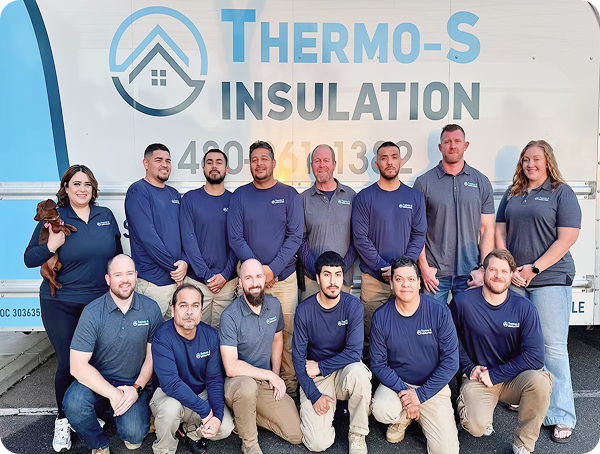
We promise to exceed your expectations by prioritizing exceptional customer service and building lasting relationships. Our commitment to quality workmanship, cleanliness, and comprehensive warranties sets us apart. Your satisfaction is our top priority!

Your home could qualify for significant energy savings through our test and repair program. The sooner you check, the sooner you start saving.